

Grades matter, but context matters more. In Australia, a “good GPA” depends on the gpa grading system university uses (7-point vs 4.0), your course, and the intake. Based on student files we review at PickMyUni, competitive programs often look beyond the number—WAM, prerequisites, and recent results carry weight too.
This guide explains what is a good gpa in university australia, shows how gpa scale university conversions work, and points you to calculators used by Monash, Melbourne, Adelaide, Griffith, Newcastle, and UQ.
What Is a Good GPA in Australian universitie?
On a 7-point scale, “competitive” often starts around a Credit average (≈5.0/7) and rises toward Distinction (≈6.0/7) for Dentistry, Medicine, and Law.
On a 4.0 scale, think strong B to A- range (≈3.0–3.7/4.0+) with an upward trend in recent semesters.
Programs may also state targets in WAM (weighted average mark) or a percentage band. Checkout the courses in the unit the provider uses, then convert your results to match. According to our research at PickMyUni, recent performance and key prerequisite marks often carry more weight than your overall lifetime average.
University GPA System vs WAM: Translate Before You Compare
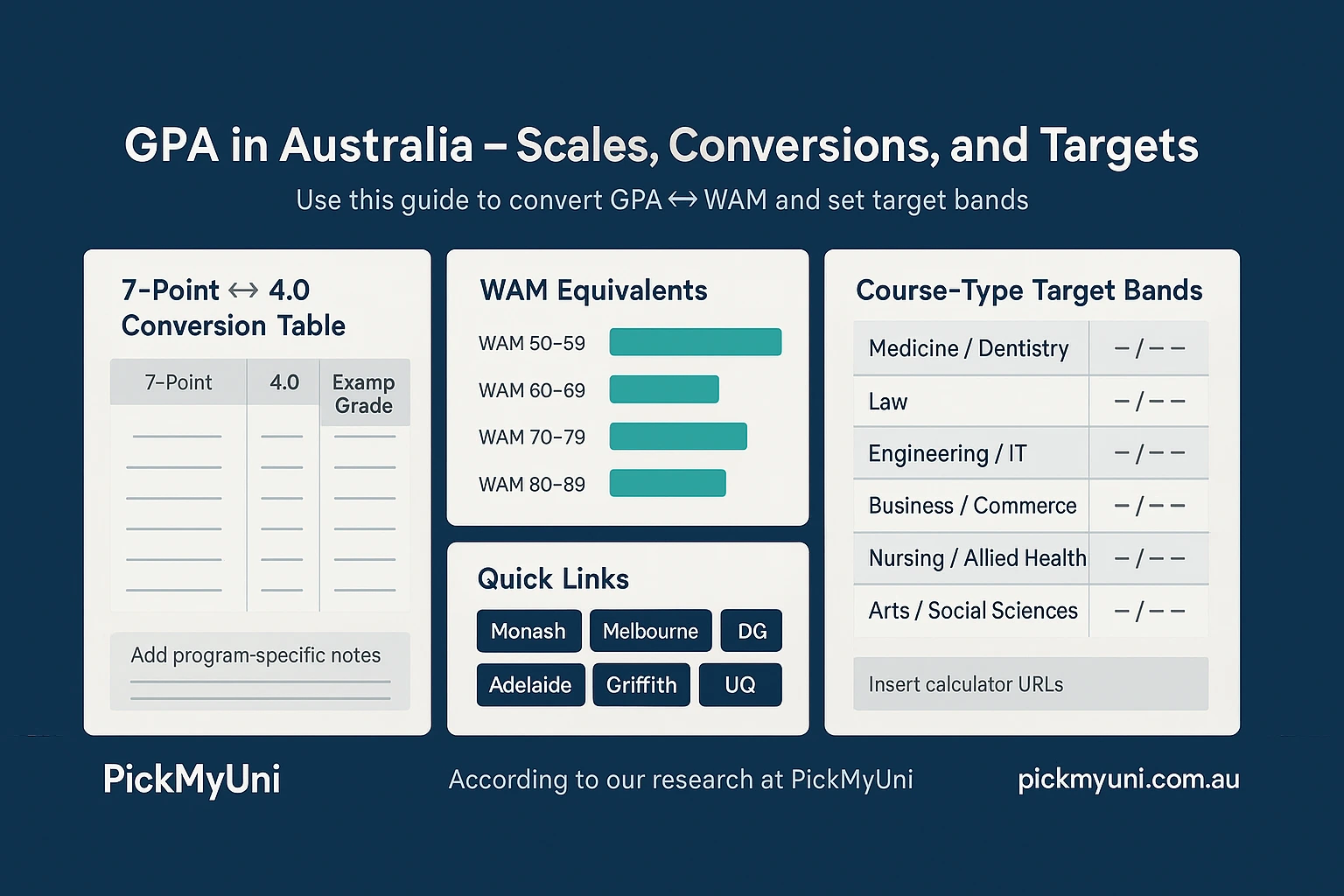
Australian providers mix GPA, WAM, and percentages. Before you chase a number, convert to the format your target course uses. Below is a plain guide to the university GPA system and common 7 ↔ 4.0 patterns with rough WAM equivalents so you can benchmark without guesswork. Always cross-check with the official calculator for your provider.
University GPA Grading system (typical meanings)
7 = High Distinction (HD)
6 = Distinction (D)
5 = Credit (C)
4 = Pass (P)
<4 = Fail
Back-of-the-envelope conversions (approximate)
6.0/7 ≈ 3.5–3.7/4.0 ≈ WAM 75–79
5.0/7 ≈ 3.0/4.0 ≈ WAM 65–69
4.0/7 ≈ 2.0/4.0 ≈ WAM 50–54
These bands vary across gpa australian universities. Treat them as orientation, not policy.
Take Your Next Step
Get personalized guidance to make informed decisions about your education journey
GPA Thresholds by Course Type (Indicative Ranges)
Different fields set different bars. Health and Law tend to sit higher than Business or many Arts majors.
What moves the bar: prerequisite subjects, portfolio/audition work, and competition at a given intake.
The grid below reflects patterns we see in applications reviewed at PickMyUni.
Course area | Typical competitive band* |
Medicine / Dentistry | 6.0–6.5/7 (A-range on 4.0) + strict prerequisites & tests |
Law (LLB/JD) | 5.5–6.2/7 (B+ to A-) + strong writing units |
Engineering / IT | 5.0–6.0/7 (B to B+) with maths prerequisites |
Business / Commerce | 5.0–5.7/7 (B range), higher for prestige majors |
Nursing / Allied Health | 5.2–6.0/7 plus clinical checks |
Arts / Social Sciences | 4.7–5.5/7, portfolio may lift a lower GPA |
Ask PickMyUni to check your target course and convert your scores.
University Tools Students Actually Use
Don’t guess—use official calculators and policy pages. These tools apply your university’s gpa scale university rules, rounding, and weighting. Based on student questions we see daily, here’s what each label usually covers.
Monash University GPA calculator — 7-point GPA and WAM options on many pages.
University of Melbourne GPA calculator — program pages often prefer WAM; the tool helps align subjects.
University of Adelaide GPA calculator — guidance on local GPA rules and grade meanings.
Griffith University GPA calculator — clear notes on how grades contribute and progression rules.
University of Newcastle GPA calculator — quick self-check for program eligibility.
University of Queensland GPA calculator — UQ’s 7-point conventions and selection notes.
International Students: Convert Transcripts the Right Way
Mixed grading cultures cause over or under-estimation.
The fix: convert with the university gpa system your target uses and attach the grading key from your home institution. According to our work with transfer applicants at PickMyUni, tidy documentation speeds up reviews and avoids back-and-forth.
What to prepare
Certified translations with official letterhead and signatures
Grading key from your home university (how grades map to percentages)
Course outlines showing contact hours, assessment types, and learning outcomes
Term dates and credit values to help weight results correctly
If your record uses class ranks or divisions, include that page too
How to Lift a Borderline GPA in One Semester
You can move the needle with a focused plan.
Results vary, but we’ve seen students shift from marginal to solid across one term by choosing units wisely and tightening assessment habits. Keep your workload realistic and aim for clean wins.
Practical moves
Subject mix: pick units that align with your strengths; avoid stacking heavy labs in one term.
Credit review: if repeats are allowed, target units with big weighting.
Assessment plan: map every due date; start major tasks early.
Feedback loop: meet tutors in weeks 1–2; verify expectations.
Prerequisite focus: secure high marks in the units your target course cares about most.
GPA in Australia - Scales,Conversions and Targets
Trying to switch courses or providers? We’ll show you the fastest path.