

Many students repeat units they’ve already mastered. Recognition of Prior Learning lets you convert past study and work experience into credit so you can transfer sooner, save on fees, and avoid duplicate content. This guide explains what recognition of prior learning means, how RPL assessment works in Australia, and what UTS, RMIT and TAFE NSW expect. PickMyUni can review your case and help you submit a stronger application.
RPL turns previous study, short courses, and job experience into advanced standing, unit exemptions, or credit transfer.
The gains show up in three places:
time saved (finish earlier),
tuition saved (skip payable units),
and a smoother transfer plan (fewer timetable clashes and repeat content).
According to our research at PickMyUni, the strongest results come from clear mapping of evidence to learning outcomes and early submission before offer dates. This page unpacks recognition of prior learning Australia policies at a high level and shares practical steps you can copy.
Meaning of Recognition of Prior Learning
“Recognition of prior learning” means a university or TAFE counts your previous formal study, informal training, or work experience as equivalent to parts of a current course.
Terms you’ll see: credit (points granted), advanced standing (entry at a later stage), unit exemption (skip a subject), and credit transfer (credit from an accredited course you’ve already passed).
recognition of prior learning = assessing what you already know and can show
credit transfer = credit from prior accredited study
advanced standing = start beyond first semester or first year
unit exemption = you don’t take the unit, often with credit attached
How RPL Works in Australia (Process + Timeline)
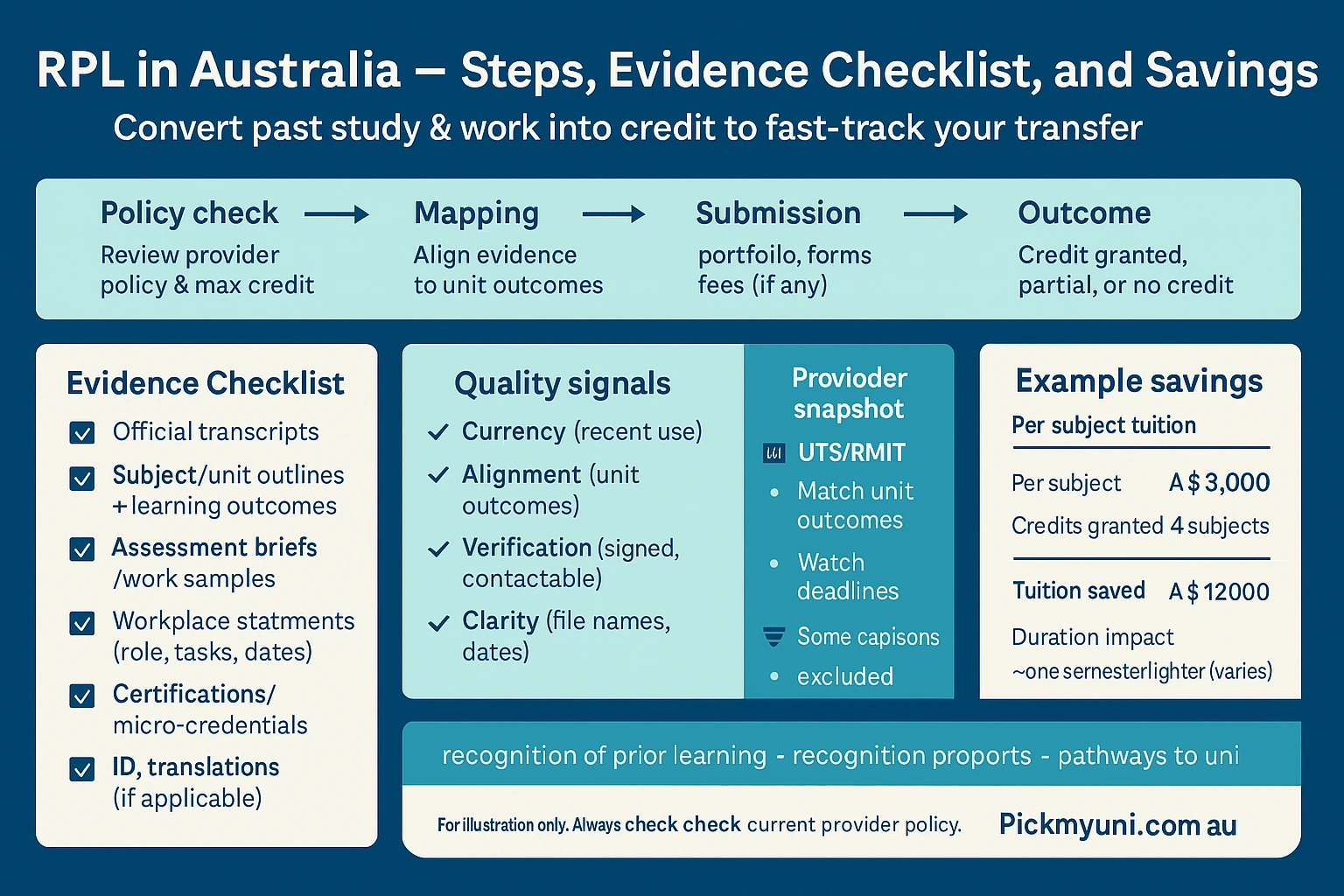
The RPL process is structured but practical. You check policy, gather evidence, map it to unit outcomes, submit, and receive a decision. Based on student transfer files we review at PickMyUni, tidy evidence and outcome-matching shorten back-and-forth.
How to Apply for a Recognition of Prior Learning
- Check policies for your target course and provider.
Map your evidence to each unit’s learning outcomes (make a table).
Prepare a portfolio: transcripts, subject outlines, assessment briefs, workplace statements, certifications.
Submit per provider form; some courses may ask for gap tasks or interviews.
Receive outcome: full credit, partial credit, or no credit.
Confirm a revised study plan before enrolment.
Timing tips for Students looking for RPL
Aim to submit 8–10 weeks before main intakes (Feb/Mar, Jul).
If you’re on tight timelines, send what you have and flag more documents incoming.
Keep certified copies handy for quick requests.
Ask PickMyUni to map your units and estimate credit. We’ll review your documents and the flag likely wins. |
Take Your Next Step
Get personalized guidance to make informed decisions about your education journey
Recognition of Prior Learning Assessment — What Reviewers Look For
An assessor checks currency (how recent and used your knowledge is), alignment with the unit’s learning outcomes, and verifiable evidence. Clear mapping beats a stack of PDFs every single time. This is the heart of a recognition of prior learning assessment.
Build a unit-by-unit mapping table
Unit code | Unit learning outcome | Your evidence | Match strength | Notes |
ABC123 | Apply SQL joins to business data | 2023 subject outline + final project repo | High | Covers inner/left/right joins |
ABC234 | Design RESTful endpoints | 2022 work log + API spec snippets | Medium | Add evidence of auth and rate limit |
ABC345 | Present findings to stakeholders | Client presentation slides | Medium | Add supervisor letter confirming role |
Common pitfalls
Evidence lists skills but doesn’t link to the unit outcome.
Outdated experience with no recent example.
Unsigned or non-verifiable workplace statements.
Portfolio format chaos (mixed naming, missing dates).
Assuming “everyone gets this credit” with no proof attached.
RPL University Examples: UTS, RMIT & TAFE NSW
Policy names vary by provider, yet the logic is consistent: show equivalence against outcomes and verify recency. Below are practical notes from transfer cases we see at PickMyUni. Always check the latest course offering before applying.
UTS recognition of prior learning
Evidence that mirrors unit outcomes and assessment tasks lands best.
Keep deadlines in mind around offer and enrollment dates.
University of Technology Sydney publish course-specific notes on maximum credit and capstone rules for some courses.
RMIT recognition of prior learning
Two streams pop up often: block credit from completed diplomas, and course-specific credit mapped unit by unit.
For informal learning, include a concise portfolio: role, tasks, tools, dates, outputs.
Recognition of prior learning TAFE NSW / TAFE recognition of prior learning
RPL is competency-based; workplace evidence and third-party reports matter.
Use competencies to ladder into uni with partner pathways where available.
Send your course list to PickMyUni; we’ll flag likely credit at each provider.
Fees & Savings: Does RPL Reduce What You Pay?
Some providers charge an RPL assessment fee, and many waive fees for straight credit transfer from prior accredited study. The bigger saving is usually time: fewer subjects means lower tuition overall. Policies can differ by course and level (VET vs higher ed). We can run scenarios based on your target course.
Simple calculator example
Course cost per subject: A$3,000
Credit granted: 4 subjects
Tuition saved: 4 × A$3,000 = A$12,000
New duration: one semester lighter (subject to study load rules)
PickMyUni can estimate savings before you apply.
Courses That Commonly Grant RPL
Business, IT, engineering tech, nursing, project management, and VET-to-uni pathways often show clear credit precedents. Published precedent databases can help you set realistic expectations.
How to read credit precedents and guides
Check validity dates and any caps on maximum credit.
Read exceptions carefully (e.g., placement or capstone not credited).
Caution on professional accreditation units
Some units are tied to industry accreditation. Even strong experience may not replace capstones, clinical placements, or regulated practicum.
Careers Impact — Will RPL Affect Employability?
Credit removes duplication; it doesn’t water down your degree. The key decision is which units to keep for employability—especially capstones, labs, placements, and industry projects.
Employer-valued units and experiences
Capstone projects with real clients
Internships or placements recorded on your transcript
Portfolio-rich assessments (code repos, design folios, case write-ups)
“Keep or credit?” quick grid
Unit type | Keep | Credit |
Capstone / thesis | ✓ often wise for portfolio and referees | |
Core theory with perfect equivalence | ✓ usually safe | |
Industry placement / clinic | ✓ keeps contacts and hours | |
Elective with overlap | ✓ free up time for advanced units |
Common Myths About RPL
A few myths cost students time. RPL isn’t “automatic.” Work experience can count if it’s mapped to documented outcomes with verification. International study can earn credit with official outlines, translations, and grading scales. Credit outcomes vary by course; two similar degrees can treat the same evidence differently.
“Everyone gets the same credit.” → Policies vary by course and evidence.
“Work experience never counts.” → It can, with mapped outcomes and proof.
“Older study is useless.” → Add currency evidence that shows recent use.
“Capstones can always be credited.” → Often protected due to learning goals.
How PickMyUni Helps
Based on transfer cases we see at PickMyUni, the fastest wins come from clean unit mapping and early evidence collection. Our team focuses on clarity, not volume, and keeps your plan on the rails through offer and enrollment.
1:1 credit pre-check: we scan your history and target units for likely credit.
Drafting your mapping table: outcome-by-outcome with tidy filenames.
Liaising with admissions after outcomes: sharpen appeals or supply extra proof.
Upload your transcripts to PickMyUni for a free credit pre-check.
Not happy with your outcome? We’ll help you request a review.
FAQs on Recognition of Prior Learning
Fast answers to the most searched questions on RPL in Australia. For course-specific rules, always read the provider page or ask us to cross-check.