

Eyeing a 1 year internship course in RMIT to fast-track employability? This guide maps the real value of RMIT’s Work Integrated Learning (WIL) model—how placements, industry projects, and supervision turn into portfolio pieces, references, and interview stories. You’ll see where interns grow fastest (communication, tooling, stakeholder habits) and how to land a strong host match.
We’ll cover eligibility, timelines, documents, and backup options if a placement falls through. Want a quick read on fit? Book a free call and we’ll match you to the right RMIT internship courses, sanity-check prerequisites, and compare similar programs if you want options.
Why a year-long internship can change your first job
Australian recruiters value live project cycles more than extra electives.
A 9–12 month stint yields stronger references and clearer “impact” stories.
Our advising note: students who prepare a skills matrix before placement interviews land better roles.
Talk to a PickMyUni counsellor—check your eligibility in 10 minutes.
What is “RMIT WIL” in plain terms
RMIT WIL = Work Integrated Learning: for-credit placements, industry projects, and clinics run with partner organisations.
WIL links to capstones/majors through learning contracts, supervised milestones, and formal assessment.
The Internship Course at RMIT components appear in many degrees across Business, STEM, Design, and Health—often as electives or structured WIL units.
Take Your Next Step
Get personalized guidance to make informed decisions about your education journey
Who the 1-year format suits
Students with room for an extended placement year or two semesters of WIL.
Career-switchers who need proof beyond grades.
International students seeking local experience ahead of graduate roles.
RMIT Internship structures Comparison
Duration | Credit load (guide) | Host type | Typical tasks | Assessment | Backup path |
Full year placement | ~48–60 cp | Mid-size tech/consulting | Sprint tasks, feature delivery, client demos | Learning contract, logs, host eval, reflection | Shift to two shorter blocks if scope narrows |
Two-semester split | 2 × ~24 cp | Two different hosts | Product support first, then growth/marketing | Two milestone sets, comparative reflection | Convert one block to an industry project |
Co-op style rotations | ~60 cp across 3 rotations | Large enterprise departments | Rotation briefs, cross-team shadowing | Rotation reports, supervisor ratings | Extend final rotation; consolidate into one host |
Capstone + placement blend | ~24 cp placement + capstone | Startup or lab + uni capstone | Prototype build, testing, showcase | Capstone grading + host feedback | Switch to capstone-only if host withdraws |
Research + industry pilot | ~36–48 cp | R&D team/analytics lab | Data pipelines, PoC studies | Methods log, poster/paper, host eval | Re-scope to a uni-run applied project |
NGO / social enterprise track | ~24–48 cp | Not-for-profit, council | Service design, comms, grant support | Stakeholder diary, artefact pack, reflection | Move to simulated community brief |
Remote/hybrid host | ~24–48 cp | Distributed team | Async sprints, documentation | Stand-up records, demo videos, logs | On-campus client simulation for missing hours |
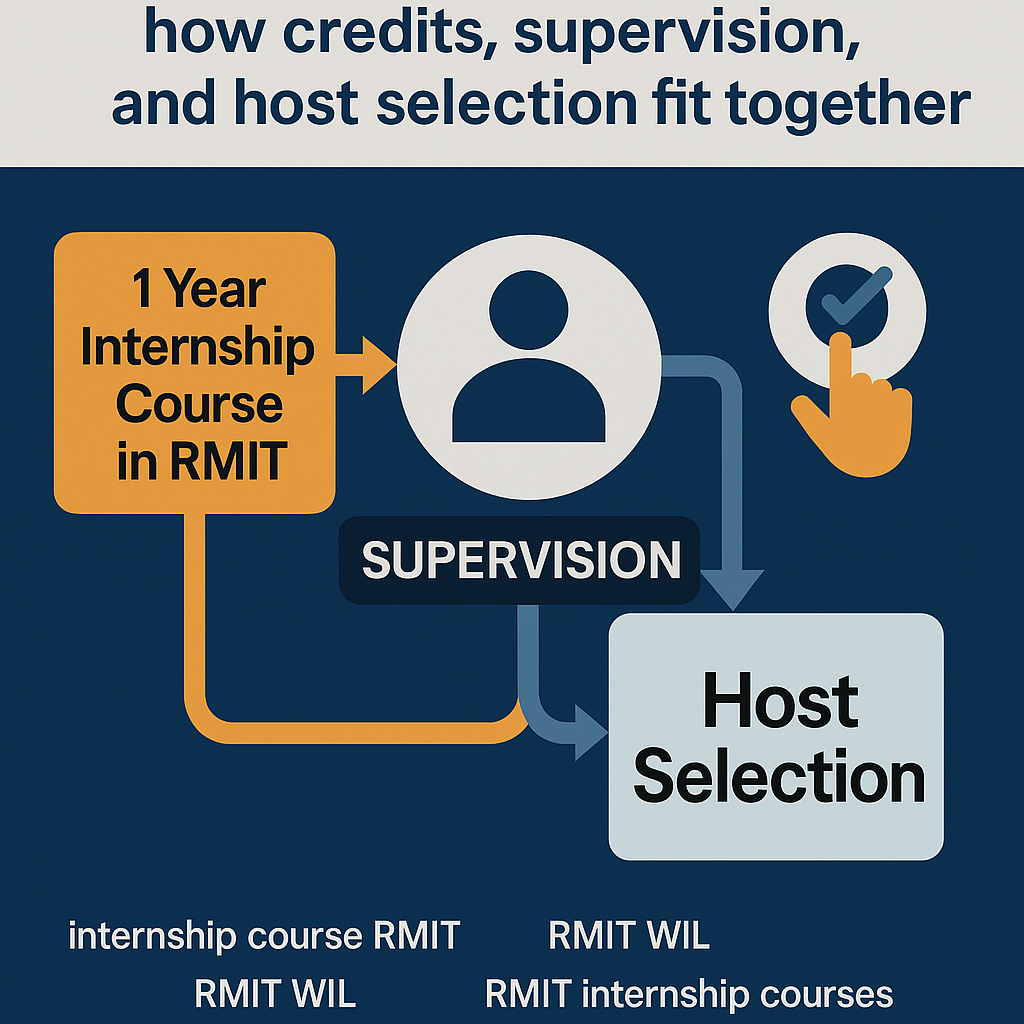
What you will learn in a 1-Year Internship Course at RMIT
Delivery habits: stand-ups, sprint reviews, stakeholder updates, documentation that future teams can use.
Technical/tool growth: analytics stacks, CAD, prototyping, version control, A/B tools—whatever the host runs.
Business fluency: scoping, light budgeting, client etiquette, risk notes.
Evidence to collect: before/after metrics, screenshots, pull requests, feedback emails, mini case studies.
RMIT 1-Year Internship Course Entry checks and timing
Eligibility: GPA or progress rules, any course-level prerequisites, and work rights that match the placement schedule.
When to apply: aim a teaching period ahead to clear matching and compliance steps.
Insurance/host compliance: confirm placement agreement, supervision plan, hours per week, and safety coverage before day one.
How matching works (and how to stand out)
Portfolio/Resume: show role-ready samples; tailor to a host’s stack or toolkit.
Smart shortlist: weigh company size, industry fit, supervision capacity, and project scope.
Interview prep: frame problems, walk through past projects, and outline “what I’ll do in month one.”
Assessment & support during the RMIT internship
Expect a learning contract, milestone logs, reflective tasks, and a host evaluation near the end.
If something stalls, email the WIL coordinator early—use the escalation path listed in your unit outline.
Convert placement work into assessable outputs without sharing confidential data: redact, summarise, or rebuild with public datasets.
Money, schedules, and visas Requirement for RMIT Internship
Paid vs unpaid: both exist; confirm stipend or wage in writing and ask about hours and public holidays.
Hours per week: varies by unit and host; plan around key study dates and any holiday blocks.
Visa basics (international): stay within permitted work hours and maintain enrolment load; keep copies of your placement agreement.
Backup plans if placement falls through
Shift into industry projects on campus or simulated client briefs.
Swap to a shorter WIL block, or split the year across two hosts.
Use micro-placements to fill evidence gaps for graduate applications.
RMIT 1-Year Internship Course Documents checklist
Resume/portfolio (track changes per role).
Academic transcript + enrolment proof.
Host agreement forms, insurance confirmations, work rights proof.
Skills matrix: tools you can already use vs tools you’re keen to learn.
Common mistakes & quick fixes
Treating WIL as “any job” → Fix: target hosts with clear supervision and deliverables.
Thin evidence → Fix: collect artefacts each sprint; ask for a short testimonial at handover.
Leaving compliance late → Fix: book checks the day your match is confirmed.
Only applying to big brands → Fix: add 3–4 mid-size firms with richer scope.
How to measure ROI after the Internship year
Before/after skills matrix, portfolio depth added, number of referee quotes.
Interview stories: use situation–task–action–result to show impact.
Job search velocity: count callbacks within 30 days post-placement.
Want a quick reality check on fit, credits, and host options? PickMyUni will line them up and flag risks early