
Starting at UNSW with prior study behind you? This guide explains how unsw credit transfer works, who qualifies, and the steps to check subject matches before you enrol. We’ll show you how to map course outlines, prepare documents, and avoid the usual blockers. We’ll cover the Business School rules, and what to expect across other faculties—without guessing numbers.
At a high level, UNSW wants to see that the subjects you’ve already completed are equivalent in level, depth, and learning outcomes to the ones in your new degree. That usually means lining up course outlines side by side: contact hours, assessment types, core topics, and assumed knowledge. Based on our work at PickMyUni, students who prepare this comparison clearly are far more likely to get a smooth decision and fewer follow-up emails.
You’ll also need to understand the difference between credit as unspecified electives and credit against specific core subjects. Many students arrive expecting every previous subject to “count”, but universities, including UNSW, focus on preserving the integrity of the new degree. This guide will help you set realistic expectations, so you’re not surprised by a lower credit outcome or extra prerequisite requirements.
Why credit transfer at UNSW matters for students switching courses
Shaves time off your degree and trims tuition load.
Clears repeated subjects so you move to advanced classes faster.
students who pre-map units before offer acceptance avoid timetable pain later.
Talk to a PickMyUni counsellor—check your eligibility in 10 minutes.
What “UNSW credit transfer” means
Credit vs. advanced standing vs. exemptions:
Credit = you don’t need to take an equivalent UNSW course.
Advanced standing = you start at a later point because of prior learning.
Exemption = a requirement is waived, sometimes without unit credit.
Block credit vs. specific course credit:
Block credit counts a group of units as electives.
Specific credit maps to a named UNSW course and appears in your plan.
Take Your Next Step
Get personalized guidance to make informed decisions about your education journey
Who can apply for a UNSW credit transfer?
New undergraduates with prior uni or pathway study.
Postgrad students with equivalent coursework.
International transfers and domestic pathway students.
“Equivalence” usually means comparable learning outcomes, contact hours, and assessment depth.
How credit is assessed at UNSW
Prior unit | Your institution | UNSW target course | Match basis (LOs, hours) | Possible outcome | Notes |
Introductory Accounting | Overseas university | First-year Accounting course (Business) | LOs align on double-entry, financial statements; hours similar | Close match | Likely specific credit for BCom core/elective depending on major rules |
Microeconomics I | Australian pathway provider | First-year Microeconomics | LOs align; hours slightly lower | Partial | May land as elective if contact hours fall short |
Programming Fundamentals | Polytechnic | Entry-level Programming | LOs align on control flow/data structures | Close match | Provide lab sheets to confirm practical hours |
Calculus A | Overseas uni | First-year Calculus | Topics align; assessment depth unclear | Partial | Add exam outline; could be elective only |
Design Studio 1 | Private college | Studio-based Design | Studio hours unclear vs UNSW | No match—request elective credit | Provide portfolio + weekly schedule |
Research Methods for IT | Overseas uni | Information Systems Methods | LOs overlap but tools differ | Partial | Include reading list and assignment briefs |
Statistics for Business | Local TAFE/college | Business Statistics | LOs align on inference/regression | Close match | Often maps to BCom quantitative requirement |
Materials Science Intro | Overseas uni | First-year Engineering Materials | Labs differ | Partial | Might be elective in Eng plan due to lab accreditation |
Document Checklist for UNSW Credit Transfer
Official transcripts and grading scale (PDF).
Detailed subject outlines: weekly topics, assessment tasks, and contact hours (lecture/tutorial/lab).
Program structure from your current/previous uni.
English translations where needed.
Tip: label files with unit code – title – year – semester to speed review.
How to read the UNSW credit transfer list and course pages
Students often look at precedent databases and past outcomes. Treat these as guides, not guarantees—course content and rules change.
Cross-check every target course with the current UNSW Handbook year to avoid outdated matches.
No precedent showing? Submit full outlines and request a course-level assessment. That’s common and fine.
UNSW Credit Transfer: Commerce-specific rules
Max Credit Transfer UNSW commerce
Expect program-level caps and residency requirements (a minimum number of UNSW units completed at UNSW).
Caps protect program integrity; plan majors and free electives with the cap in mind.
Bachelor of Commerce Credit Transfer UNSW
Understand core vs. major vs. elective credit.
Common clean matches: introductory accounting, economics, business stats.
“Partial match” appears when contact hours or assessment depth fall short—often redirected as elective credit.
Business Credit Transfer UNSW
Major notes:
Finance: methods and quantitative depth matter; include assignment briefs.
Marketing: theory is easier to match than applied projects; include assessment details.
Information Systems: show tools/stacks used and any group project artefacts.
Evidence that helps: assessment briefs, sample assignment prompts, and reading lists.
Other credit transfer faculties in brief
Engineering/IT: labs and accreditation constraints weigh heavily. Supply lab manuals, software lists, and hours.
Science: prerequisite chains are strict; lab hours matter.
Arts, Design & Architecture: studio/portfolio evidence helps with practice-based subjects.
Health-related courses: accreditation bodies tighten what can be credited—expect closer checks.
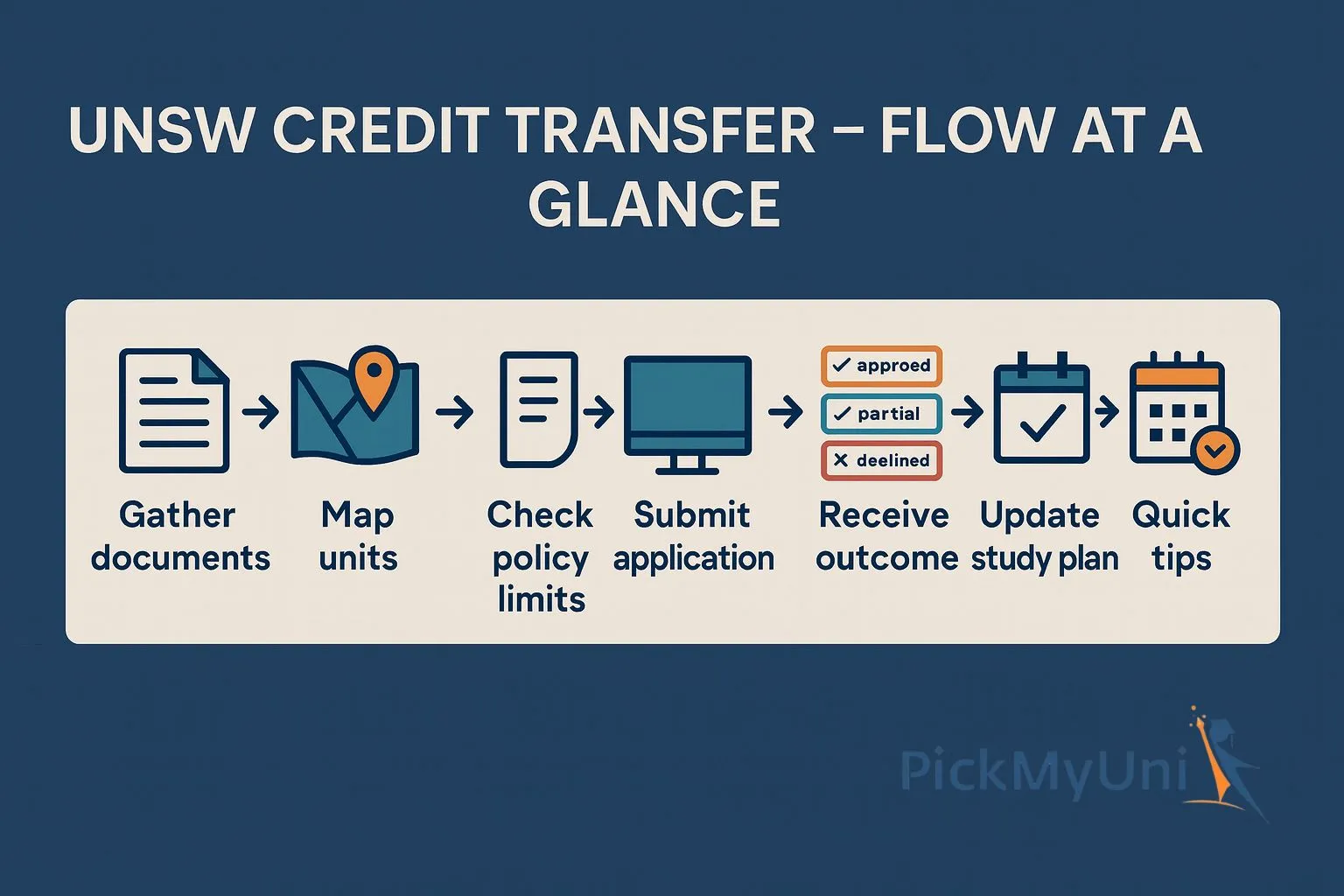
Step-by-step process for applying for course Credit Transfer at UNSW
Map your prior units to UNSW targets using Handbook learning outcomes.
Confirm session/year rules in the current Handbook.
Prepare files: transcript, grading scale, detailed outlines.
Submit the credit request via the correct portal/form.
Track status and respond quickly to any requests for extra detail.
Update your study plan once results land.
If UNSW isn’t the best fit, PickMyUni can line up alternatives.
Timing, results & enrolment impact during credit transfer
Submit before enrolment where possible so you can plan majors and prerequisites cleanly.
Decisions land as approved / partial / declined.
After outcomes, adjust your term plan: swap duplicates, keep prerequisite chains intact, and watch full-time load rules.
Keep dates dynamic—confirm live timelines on the official page and in your offer.
Grading scales, GPA conversions & subject currency
Reviewers read your grading scale to interpret marks; include the official legend.
Older subjects may trigger a “currency” check. If content has moved on, provide proof of current skills (projects, certifications).
If your scale is uncommon, attach the awarding institution’s explanation page or PDF.
Common mistakes during UNSW credit transfer process & quick fixes
Submitting outlines without weekly topics → ask your old uni for the full version.
Mapping to the wrong Handbook year → use the current edition unless told otherwise.
Ignoring prerequisite chains → secure credit for the exact gatekeeper subject.
Uploading unofficial transcripts → request certified PDFs.
Make UNSW Credit Transfer work for your degree plan
In the end, unsw credit transfer is really about shaping a sensible degree plan, not chasing the highest possible number of units. The stronger your match on learning outcomes, contact hours, and assessment depth, the more likely you are to see useful core and elective credit—not just random electives you’ll never use.
Students who treat credit transfer as part of their planning (mapping units against the current UNSW Handbook, checking prerequisite chains, and thinking through majors) usually end up with cleaner timetables, fewer repeat subjects, and a smoother start in their new program. If you’ve studied accounting, economics, business stats, or first-year core subjects elsewhere, it’s worth doing a careful check before you lock in your enrolment.
Done well, credit transfer at UNSW can:
Cut down your total study time and tuition load
Clear space for a double major or more flexible electives
Help you move into advanced courses earlier, without nasty prerequisite surprises
Get a free UNSW credit transfer pre-check with PickMyUni
If you’re unsure how many of your subjects will count at UNSW—or worried you’re mapping them to the wrong courses—PickMyUni can step in before you commit.
Our counsellors can:
Look over your transcripts, grading scale and subject outlines
Suggest likely UNSW matches for Business School and other faculties
Flag weak spots (old subjects, low contact hours, missing labs or accreditation issues)
Compare UNSW with alternative universities that might recognise more of your credit
Share your documents with a PickMyUni counsellor, get a clear read on your unsw credit transfer chances, and then decide if UNSW is the right fit—or if a different uni will give you better recognition for the study you’ve already completed.