

If illness, hardship, trauma, a bereavement, or another serious event hits right around an assessment due date or exam, special consideration is the formal way most Australian universities can give you fair academic treatment. That might mean an extension, a deferred/special exam, an alternative assessment, or (sometimes) a re-weighting—but it’s not automatic, and it usually needs supporting documents. Deadlines are tight (often 2–5 working days, or even same-day at some unis), and many places use a “fit to sit” rule for exams/timed tasks. Below is a student-friendly guide to apply for special consideration, avoid the common traps, and check what each uni expects.
The “why” behind special consideration
At PickMyUni, we see students panic because special consideration sounds like “they’ll just give me extra time.” In practice, universities treat it as a formal equity process: they’re trying to be fair to you and everyone else in the class. That’s why the rules can be firm on evidence, timing, and what outcomes are allowed.
For example, The University of Melbourne describes special consideration as a one-off adjustment applied close to or shortly after the due date, and it won’t simply “change your mark” (except cases like approved re-weighting).
What is Special Consideration?
Special consideration is a formal application asking the university to adjust an assessment requirement because circumstances beyond your control significantly affected your ability to complete or perform in that assessment.
Depending on the university and assessment type, outcomes can include:
Extension (often aligned to the proven impact period)
Deferred/special exam or rescheduled assessment
Alternative/additional assessment (task replaced or changed)
Re-weighting/waiving small tasks in limited cases (policy-dependent)
Take Your Next Step
Get personalized guidance to make informed decisions about your education journey
Common reasons that usually qualify
What often qualifies (examples vary by uni):
Short-term illness/medical episodes, mental health events, injury
Bereavement
Trauma, victim of crime
Serious hardship
Jury duty/court summons
Defence/SES obligations
Most unis also clearly list what doesn’t qualify, like misreading the timetable, travel plans, normal work commitments, or general stress around study. For instance, CSU’s procedure lists ineligible examples like misreading an exam timetable or due date, holidays, and “stress or anxiety normally associated with assessment tasks.”
The biggest trap: “Fit to Sit”
A lot of exam special consideration problems come down to one rule: if you sit/access a timed assessment, the uni may treat that as you declaring you were well enough to attempt it.
UNSW is very direct: if you access/sit a timed assessment, you’re declaring yourself fit to do so and you may no longer be eligible. They also outline what to do if you become unwell mid-assessment (stop, notify staff, apply fast with evidence).
Macquarie warns that if you submit or attempt at the scheduled time/due date, you may not be eligible.
JCU explicitly explains “Fit to Sit” and ties it to submitting within the timeframe for the category you choose.
PickMyUni tip: If you’re sick before a timed exam, don’t try to “push through” unless you’re genuinely able. The admin headache later can be worse than missing the exam.
How to Apply for Special Consideration - Step-by-Step Process
Use this as your default checklist for how to apply for special consideration anywhere in Australia.
Step 1) Decide what you’re asking for
Universities often separate pathways:
Assignments / due-date assessments
Faculty tests / quizzes
Centrally-run exams
Placements / mandatory attendance
UTS, for example, sets different deadlines depending on whether it’s a centrally-conducted exam, a faculty-based quiz/test, assessments, or clinical placement.
Step 2) Check the deadline first
Deadlines are short and strict.
University of Melbourne: apply no later than four business days after due date/missed class, and they can hold your application for up to four business days while you get documents.
Monash: deadline is 11:55pm on the day the assessment is due/scheduled (and late applications are generally not accepted unless extreme circumstances prevented you applying).
UNSW: generally within 3 working days after the assessment due date.
Macquarie: within five working days of the assessment due date.
CSU: apply no later than three working days after the exam date (unless circumstances prevented earlier).
Step 3) Get evidence that proves impact + dates (not just a diagnosis)
Most unis want documents that show:
What happened
When it affected you
How it affected your study/assessment
UniMelb says supporting documents should outline impact, dates, and duration; they also warn about fake documents and verification
ACU requires evidence and states timing: submit prior to, or up to five working days after, the due date; outcome notification is within 10 working days.
Step 4) Submit the application in the right portal
Many unis require separate applications per task.
UTS states you must submit a separate application for each assessment/exam impacted.
JCU similarly notes onnts. e application per assessment per category, with separate submissions for multiple assessme
Step 5) Keep working (don’t pause life waiting for approval)
UNSW explicitly says: don’t wait for approval before submitting; keep working and submit when you can.
Macquarie says applying doesn’t guarantee approval and reminds students outcomes can be retrospective if evidence shows an earlier impact window.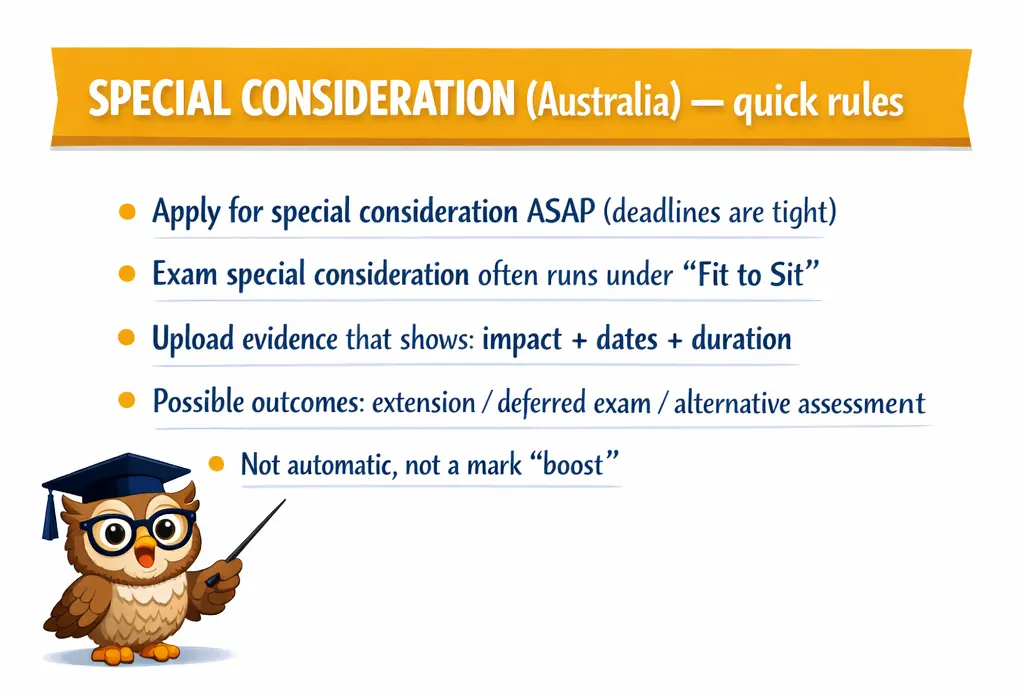
University-by-University Special Consideration
This is not every detail (each faculty can add rules), but it’s the stuff that trips students most.
Monash special consideration | The deadline is 11:55pm on the due/scheduled day; short extensions exist; outcomes can arrive within one working day for short extensions and within three working days for special consideration if complete. |
UNSW special consideration | apply within 3 working days after the due date; “Fit to Sit” is strict for timed tasks; outcomes commonly include extension, alternative assessment, or aggregated marks. |
UTS special consideration | deadlines differ by assessment type (example: centrally-run exam “attended” = within 48 hours excluding weekends; faculty tests often within 2 working days; long extensions must be requested before the due date). |
Special consideration University of Melbourne | apply within four business days after due date/missed class; extensions usually match the proven impact window; current processing times are posted on the page. |
apply within five working days; outcome target within five working days after complete evidence is received. | |
Special consideration Charles Sturt University | outcomes can include deferred exam, alternative task, extensions/grade pending; for deferred exams, apply no later than three working days after the exam date (with evidence). |
ACU special consideration | submit prior to, or up to five working days after, the due date; outcome notification targeted within 10 working days. |
JCU special consideration | has clear category tables with timeframes (including same-day for some short extensions and 2 working days for several categories); also explains “Fit to Sit.” |
For Deakin special consideration, QUT special consideration, special consideration UWA, VU special consideration, SCU special consideration, and special consideration Swinburne, the key pattern is the same: short submission windows + evidence that links dates to impact. Always use your uni’s official page first because faculty rules can be tighter than the central rule.
What is a “petition for special consideration”?
In Australia, students sometimes say “petition” when they mean a formal written request for an academic adjustment—often:
a special consideration application itself, or
a review/appeal after the outcome
Some unis formalise reviews (UNSW, UniMelb, others) with tight timelines and “grounds for review.”
If your uni calls it a petition, treat it like a legal form: clear dates, clear impact, clean evidence.
What happens if you get special consideration?
It depends on assessment type and what the university thinks is fair:
You might get an extension (often based on impact period)
You might get a deferred exam/special exam
You might get an alternative task
You might get re-weighting for small assessments (policy-dependent)
Or your application can be declined (still common even with real issues if deadlines/evidence don’t match)
The real risks of crediting special consideration the wrong way
Here are the risks PickMyUni sees most often:
Missing the deadline
Even genuine situations can be declined if you submit outside the window.“Fit to Sit” problems
Sitting a timed assessment can remove your eligibility.Evidence that doesn’t match dates/impact
Most rejections come from documents that confirm you were sick… but don’t confirm you were impacted during the assessment period.Academic integrity/misconduct
Unis warn about verification and serious penalties for falsified documents.
Special consideration can affect transfers too
If you’re thinking, “This uni’s policy is too stressful, I want to move,” you’re not alone. Special consideration rules (deadlines, evidence, exam policies) are one of the quiet reasons students ask PickMyUni about switching universities or changing courses.
If you tell us:
your uni,
your course,
whether you’re facing missed assessments/exams regularly,
we can help you compare support processes and study structures before you make a move. (Also: if you’ve had a good or bad experience with your uni’s process, consider leaving a review—your story genuinely helps other students choose smarter.)