

The Ultimate Guide to International Student Travel Passes for Budget Travelers
An international student travel pass gives eligible full-time students discounted public transport on trains, trams, and buses. Most systems require proof of full-time enrolment and a valid student ID; some add age or concession-card rules.
Savings vary by city and zone, but many students report double-digit weekly reductions that add up to hundreds each semester. This guide explains how passes work, who qualifies, what documents you’ll need, and how to apply—plus examples for RMIT, Deakin, and Monash, including international student travel pass myki notes. At PickMyUni, we compare pass options by university and region, so you don’t miss a technicality or deadline.
What Is an International Student Travel Pass?
Purpose: reduce commute costs for full-time students using public transport regularly.
Common inclusions:
Zones: pricing changes by distance or region (e.g., inner vs outer metro).
Modes: trains, trams, buses; sometimes ferries or regional services.
Time-based caps: daily or weekly caps, off-peak discounts, or term passes.
International Student Travel Pass Eligibility & Required Documents
Core checklist
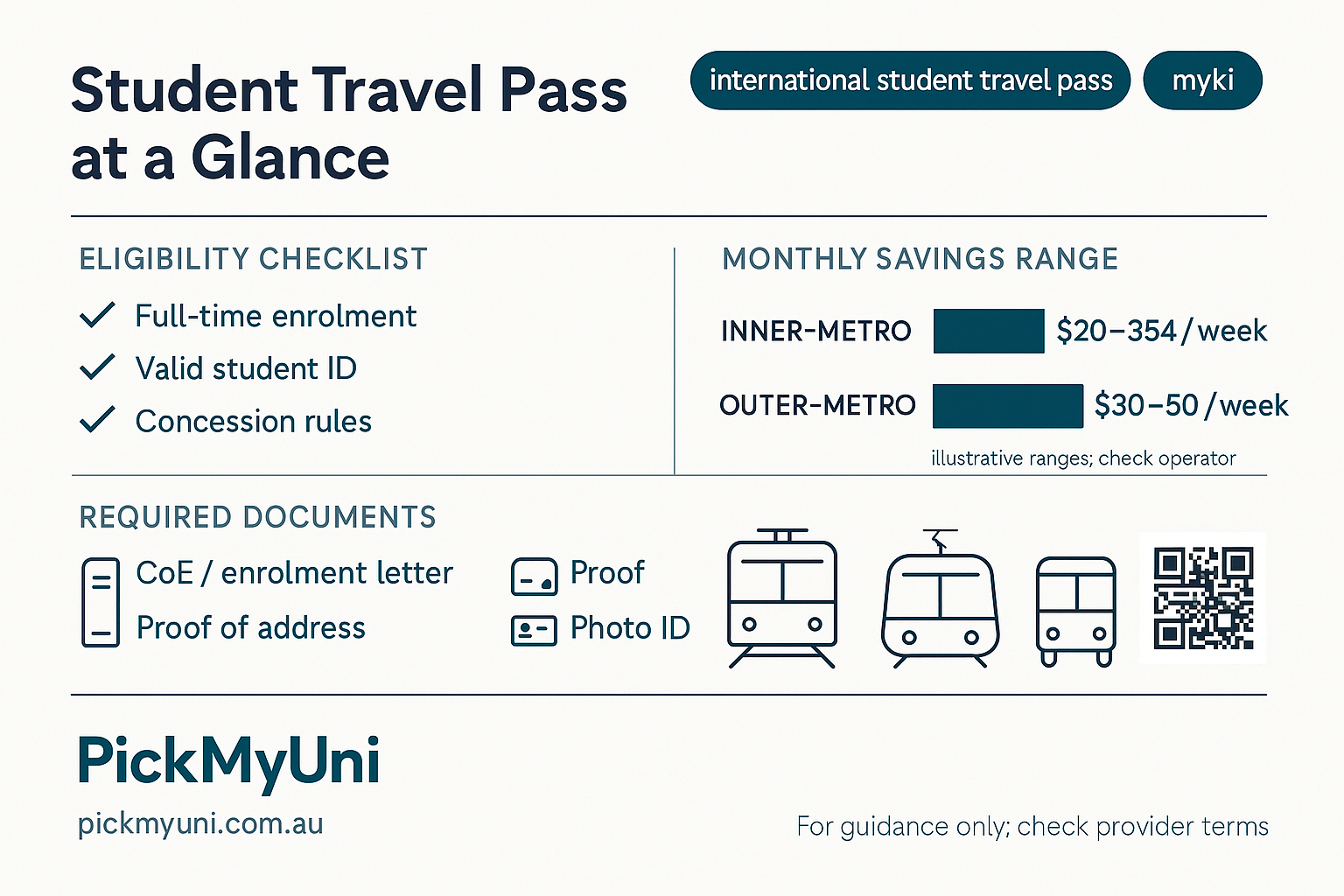
Full-time enrolment in a recognized course
Valid student ID from your institution
Age rules if the system sets youth or adult concession categories
Concession card where the transport operator requires one for student rates
Proof you’ll likely need
CoE or enrolment letter with study load noted
Photo ID (passport or local ID)
Residential address in the service area
A recent photo if your pass includes a photo card
Renewal and compliance
Keep a full-time load during teaching periods
Update address if you move zones or cities
Watch the expiry date on any concession entitlement so your fares stay valid
Take Your Next Step
Get personalized guidance to make informed decisions about your education journey
University Examples & How Passes Link to Your Campus
RMIT International Student Travel Pass
Campuses: Melbourne City, Bundoora, Brunswick.
Typical routes:
City campus: tram and train combinations, frequent short hops in the free-tram zone plus paid trips outside it.
Bundoora: tram 86, bus feeders, or train to Greensborough with bus links.
Brunswick: Upfield line trains, tram 19, and local buses.
Where to apply: Start with the RMIT University transport/concessions page, then complete the operator’s application (often online). Bring your enrolment proof when you collect or activate the pass.
Deakin University
Campuses: Burwood (Melbourne), Geelong Waurn Ponds/Waterfront, Warrnambool.
Commute patterns:
Burwood: tram links to CBD; buses connect outer-east suburbs.
Geelong: V/Line trains plus local buses; some students mix rail with bikes for first/last-mile.
Warrnambool: regional buses and rail; check regional concessions and student caps.
Action: Confirm eligibility on Deakin’s University student concessions page, then apply through the local operator.
Monash University
Campuses: Clayton, Caulfield, Peninsula (Frankston), Parkville.
Connections:
Clayton: rail to Huntingdale + shuttle, or buses direct to campus; watch for peak crowding.
Caulfield: Frankston line trains, trams, frequent buses.
Peninsula: Frankston line + local buses; regional links for placements.
Action: Confirm eligibility on Monash’s University student concessions page, then apply through the local operator.
System Spotlight—Myki for Students
Zones: Most Melbourne trips fall in Zones 1–2. Cross-zone commutes cost more, but caps limit daily/weekly spend.
Peak/off-peak: Off-peak train fares can be cheaper; leaving 10–15 minutes earlier or later sometimes changes the price.
Top-up tips:
Register your Myki to protect balance if lost.
Use auto top-up to avoid on-board surprises.
Keep your concession entitlement current so inspectors see valid status.
If you live near a zone boundary, compare costs for housing on one side vs the other—small rent differences can be offset by big fare savings.
How to Apply for an International Student Travel Pass
Step 1: Confirm eligibility on the official transport site and your university’s concessions page. Note any age or visa-neutral conditions and zone rules.
Step 2: Gather documents, create your transport account, and apply for the card or digital pass.
Step 3: Activate the card/app on your first trip and set auto top-up so you don’t dip below minimum balance.
Step 4: Track your concession expiry in your calendar; renew before it lapses to avoid full fares or fines.
Real Savings: What Students Actually Cut
Sample budgets:
Inner-metro: frequent short trips, mostly one zone. Swapping to a student pass can shave $20–$35 per week, depending on timetable density.
Outer-metro or cross-zone: longer distances and more transfers. Student rates often cut $30–$50 per week, higher if you travel most days.
Hidden wins:
Fewer late-night rideshares when caps make public transport cheaper and predictable
Better attendance at early labs and evening tutorials without stressing over per-trip costs
Lower risk of fines since registered passes can be checked, topped up, and replaced faster
PickMyUni Can Help
Ready to stop burning cash on fares?
Compare your campus commute with PickMyUni and set up the right international student travel pass before the census. We’ll point you to the correct provider page and keep you on top of renewals.