

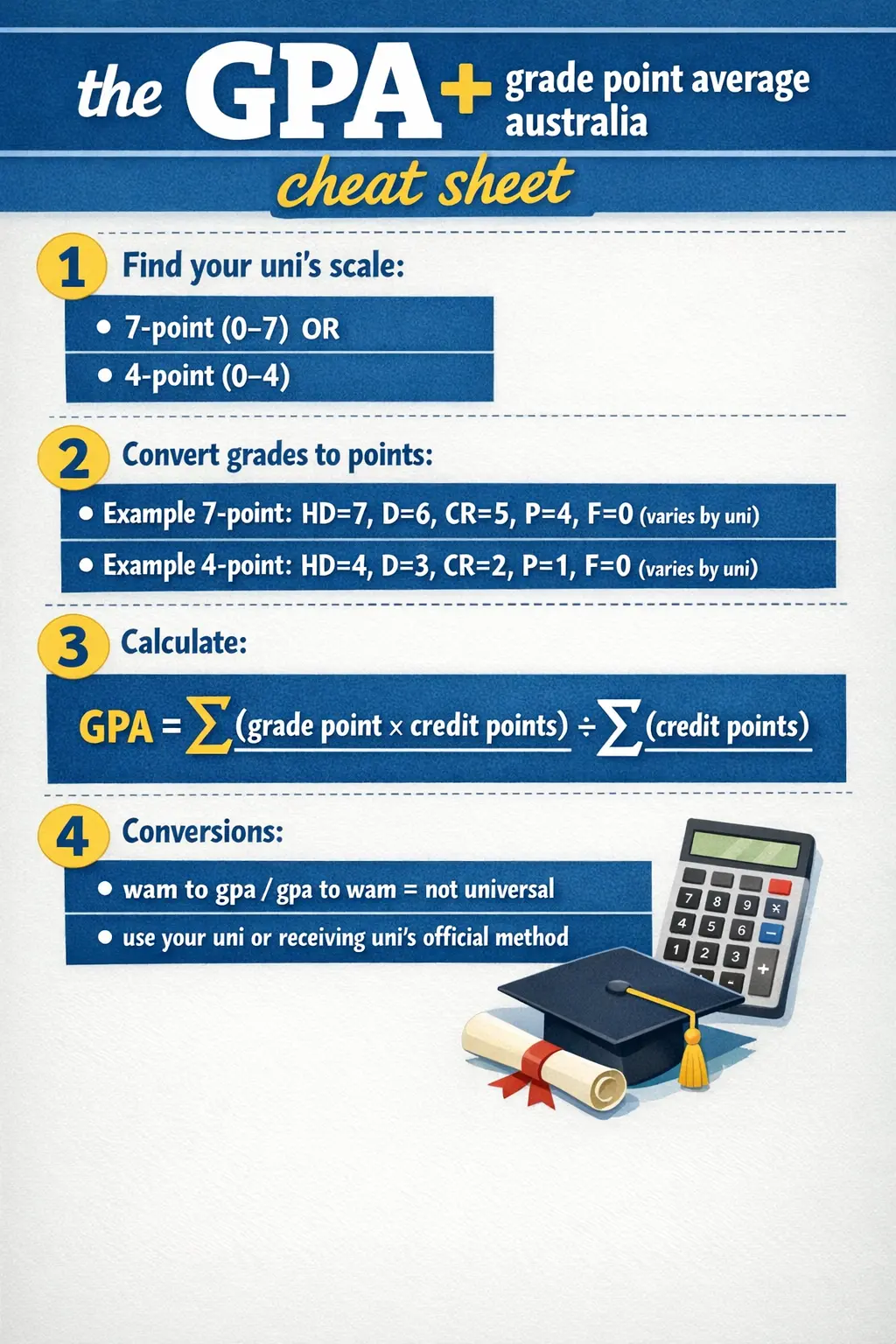
In Grade Point Average Australia, your GPA / Grade Point Average is usually a weighted average of your unit results, using a numeric scale (often 0–7 or 0–4) and weighted by credit points. Different universities apply different scales and grade-point mappings, so “good GPA” depends on your course, uni, and goal. This guide explains GPA meaning, the Australian GPA system, how to use a GPA calculator (and GPA calculator Australia options), and how WAM to GPA and GPA to WAM conversions work in real life (plus why there’s no single “official” conversion).
What is GPA?
GPA stands for grade point average. It’s a single number that summarises your academic results across a period (like a semester) or your whole course, usually weighted by credit points.
Universities often describe GPA as the average of your grades achieved across enrolled courses/subjects, weighted by unit value/credit points.
PickMyUni’s take: students get caught when they assume GPA is “one universal system”. It isn’t. Even inside Australia, the scale and the way grades map to points can change by university.
The Australian GPA system
In grade point average australia, you’ll commonly see:
7-point GPA scale (0 to 7) at many unis (example: ANU calculates GPA on a 7-point scale).
4-point GPA scale (0 to 4) at some unis (example: RMIT uses a 4-point GPA scale; Monash also states its GPA is on a four point grading scale with 4.0 highest).
WAM instead of GPA at some places (UniMelb prominently uses WAM to show overall academic performance).
So if you’re searching GPA in Australia, the right answer is: check your university’s official grading schema first.
Take Your Next Step
Get personalized guidance to make informed decisions about your education journey
How to calculate GPA in Australia
Most universities follow the same basic idea:
Convert each grade to a grade point value (based on your uni’s scale).
Multiply that grade point by the credit points for the unit.
Add them up.
Divide by total credit points attempted.
UTS publishes this style of formula (grade points × credit points, divided by total credit points).
Monash publishes a similar weighted formula (Σ(grade value × unit credit points) ÷ Σ unit credit points).
A quick example
Say you did 3 subjects, each worth 6 credit points:
HD (7) → 7×6 = 42
D (6) → 6×6 = 36
P (4) → 4×6 = 24
Total = 102. Credit points = 18.
GPA = 102 ÷ 18 = 5.67
(Your uni’s grade-point mapping can vary; always use your official table.)
GPA calculator Australia
If you want a gpa calculator that matches your uni, start with official tools/pages. Examples PickMyUni sees students use a lot:
University of Newcastle GPA calculator (7-point grading scale; shows grade values like HD=7 … Fail=0).
CSU GPA calculator (lists grade-to-point values used in its calculator).
And if you’re looking at a specific school:
GPA UTS: UTS explains GPA formula, grade points, and even how it converts to a 4-point scale as a guide.
ANU GPA: ANU shows the 7-point mapping (HD=7, D=6, CR=5, P=4, Fail=0).
University examples
Here’s what “different systems” looks like in real terms:
RMIT GPA: RMIT states it adopted a 4-point GPA scale and provides mark ranges (HD 80–100 = 4, D 70–79 = 3, etc.).
Swinburne GPA: Swinburne describes GPA as total grade points divided by total credit points attempted, and references a 4 point scale example.
Monash GPA: Monash states its GPA is on a four point grading scale and provides a weighted formula.
QUT GPA: QUT policy documents describe GPA reporting and how it’s used, and it also publishes honours GPA bands in its policy.
UNE GPA scale: UNE states it calculates GPA on a 7-point scale, with 7 the highest, and shows grade ranges like HD 85–100.
GPA Griffith University: Griffith publishes numeric grade descriptors (7 = High Distinction, 6 = Distinction, etc.) and describes academic progress using program GPA.
PickMyUni tip: if you’re transferring, applying for postgrad, or submitting an overseas application, you’ll often be asked for GPA even if your home uni talks in WAM. That’s when you want your uni’s official explanation (or the receiving uni’s conversion tool).
WAM to GPA and GPA to WAM
First: what is WAM?
WAM (Weighted Average Mark) is a weighted average of your marks (percentages), weighted by credit points.
UniMelb explains WAM as reflecting numeric marks (like 45%, 87%) and credit points, and that it’s weighted (a 25-point subject counts more than a 12.5-point one).
UTS also publishes a WAM formula and explains what gets included/excluded.
So… can you convert WAM to GPA?
Sometimes, as an estimate. There is no single official Australia-wide WAM to GPA conversion, because grading schemas differ by university. UNE explicitly says grading systems can differ from university to university.
UQ also warns its GPA calculation method may not apply to other institutions.
“75 WAM to GPA” and “3.0 GPA to WAM” examples (why it depends)
At a uni where 75–84 is Distinction and maps to 6 on a 7-point scale (UNE shows this), a 75 WAM might roughly align with a 6-ish GPA.
On a 4-point system like RMIT, 3.0 GPA aligns with Distinction (70–79) in its published table.
If you need a conversion for admission, use the receiving uni’s tool. UniMelb, for example, provides a grade conversion eligibility calculator for graduate coursework eligibility (it’s indicative and doesn’t guarantee an offer).
What is a good GPA in Australia?
“What’s good” depends on what you’re trying to do:
Just passing and progressing: on many 7-point systems, 4.0 aligns with “Pass” level in the grade-point table (example shown at ANU).
Competitive honours / high academic standing: some universities publish honours bands tied to GPA (QUT shows higher honours classifications at higher GPA ranges, like 6.50–7.00 for first class honours in its policy).
Honours at UQ (UQ honors GPA / GPA UQ): UQ policy documents explain honours GPA calculation is based on a specified set of higher-level courses within program requirements.
PickMyUni’s rule of thumb: don’t chase a “magic number” you saw online. Instead, look up the requirement for your exact goal (your faculty, your scholarship, your honours entry, or the postgrad course you want).
GPA engineering
Engineering students often search GPA Engineering for two reasons:
Engineering programs can be heavy on credit-point weighting (so a high-credit unit affects your GPA more).
People mix up GPA with GPa and MPa (units of pressure/stress). If you meant GPA to MPa / MPa to GPA, that’s usually a physics conversion, not a university grading thing.
ATAR to GPA
ATAR isn’t a university GPA and there’s no official direct ATAR to GPA conversion.
UAC explains ATAR is a number indicating your position relative to your age group (a rank/position, not a “uni grade”).
The University of Sydney also explains ATAR as your percentile position and says it shouldn’t be seen as a score.
So if you’re searching ATAR to GPA, the practical move is:
use ATAR for entry context,
use GPA/WAM for university performance context.
Need help choosing a course or planning a transfer?
PickMyUni helps students compare Australian universities and courses, and make sense of requirements like GPA/WAM when you’re planning honours, postgrad, or a course switch. If you’re thinking about changing direction, reach out to PickMyUni for a straight answer based on your uni, your course, and your goal.
And if you’ve studied at an Aussie uni already, dropping a quick review on PickMyUni genuinely helps the next student make a better call.