
If a storm, outage, medical bill, or sudden rent jump has blown up your budget, you’re not alone. At PickMyUni, we regularly hear from students who can keep studying academically—but are one unexpected expense away from pausing uni.
Here’s the good news: “emergency hardship assistance grant” can mean two different support paths in Australia—university emergency grants and government disaster hardship payments. This guide explains both, how to apply fast, what you can be paid, and what to expect for processing time.
An emergency hardship assistance grant is short-term money meant to cover essentials (food, rent, bills, medical costs) so you can stay enrolled. There are student hardship grants offered by Australian universities (usually small, quick, and evidence-based). For disaster situations, state and Commonwealth payments can be activated, such as Queensland’s Emergency Hardship Assistance (up to AUD$900 for EHA, for individuals, AUD$180) and the Australian Disaster Recovery Payment (an Australian Government disaster recovery payment of AUD$1,000 for adults, AUD$400 for children). Depending on the application, time frames differ, so the best course of action for application is this: select grants, collect forms, go online, and follow through with students.
What students mean by “emergency hardship assistance grant”
At PickMyUni, we see students use emergency hardship assistance grant as an umbrella phrase for:
University emergency grants (student hardship money)
These are usually run by student wellbeing, equity, or financial aid teams and can help with:
urgent groceries, rent, utilities
short-term accommodation risk
essential study needs (like a laptop repair or basic tech)
Example programs (to show what “normal” looks like across unis):
Monash Emergency Grant: up to AUD$500, and Monash says they aim to contact you about your application within five University working days (peak times can take longer).
ACU Urgent Financial Hardship Grant: AUD$100–AUD$1,000, deadline listed as 8 Dec 2025, and funding can run out earlier (so apply as soon as you need it).
CQUniCares Emergency Grant (CQUniversity): case-by-case, for unexpected hardship that could derail study progress.
Notre Dame financial hardship support: a dedicated financial hardship support page and pathway for students seeking help.
Government disaster hardship grants
These are not “uni grants”, but students often qualify if they live in an affected area or were directly impacted.
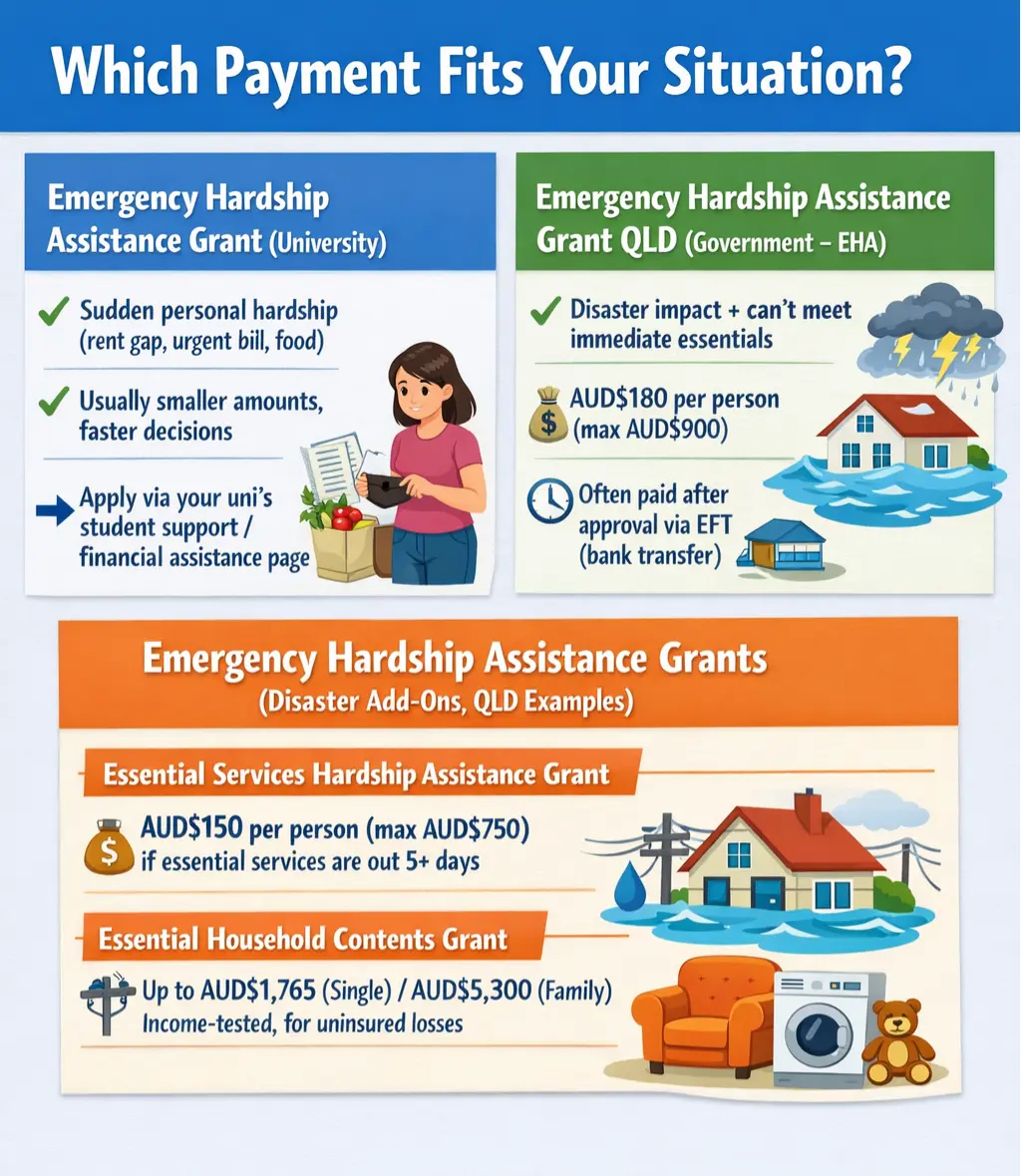
Queensland example: the Emergency Hardship Assistance (EHA) grant is AUD$180 per person up to AUD$900 for a household of 5+ and is meant for essentials (food, clothing, medical supplies, temporary accommodation). It’s not income or asset tested, and non-citizens can apply.
Take Your Next Step
Get personalized guidance to make informed decisions about your education journey
How to apply for an emergency hardship assistance grant at university
PickMyUni’s practical “don’t waste time” checklist:
Step 1: Apply to the right bucket
If it’s personal finances (rent/food/urgent tech): start with your university hardship grant.
If it’s from a declared natural disaster: apply for government disaster support too (if eligible).
Step 2: Gather documents before you start the form
Most unis ask for:
proof of enrolment (or student ID)
bank statements (recent)
bills/lease/overdue notice or receipts
a short statement: what happened + what you need the money for
Step 3: Write a simple, evidence-based explanation
Best format:
What changed (date + event)
What you’ve already tried (budget changes, part-time work, family support, payment plan)
What you need (amount and purpose)
How it keeps you enrolled (the key line decision-makers look for)
Step 4: Follow up like a pro
If you don’t hear back:
ask if they can offer food pantry, emergency vouchers, or fee/payment plan options while the grant is assessed
PickMyUni tip: if you’re considering changing course loads, transferring, or switching universities due to financial pressure, talk to PickMyUni—we can help you compare student support strength across universities and map a safer plan so you don’t lose time.
Emergency hardship assistance grant QLD
Queensland’s Emergency Hardship Assistance (EHA) is one of the most searched government programs under “emergency hardship assistance grant qld”.
Emergency hardship assistance grant amount (QLD EHA)
AUD$180 per person, up to AUD$900 for a family of 5+
Who is eligible for emergency hardship assistance? (QLD EHA)
You generally must:
be living in (or stranded in) an eligible disaster-affected area
have suffered hardship from the event
be unable to meet immediate essentials (food, clothing, medical supplies, temporary accommodation)
Emergency hardship assistance grant processing time (QLD)
If approved, it’s paid via EFT and may take up to 5 working days to appear in your account (bank processing can affect this).
Emergency hardship assistance grant Cyclone Alfred
If you searched for emergency hardship assistance to grant cyclone alfred, you were probably looking for disaster assistance activated around March 2025.
Queensland: ex–Tropical Cyclone Alfred support (March 2025)
Queensland announced Personal Hardship Assistance for specific councils impacted by ex–Tropical Cyclone Alfred, including:
Emergency Hardship Assistance Grants ($180 per person, up to $900)
Essential Services Hardship Assistance ($150 per person, up to $750)
Essential Household Contents Grants (up to $1,765 / $5,300)
Structural Assistance Grants (up to $80,000 for eligible uninsured, income-tested owner-occupiers)
New South Wales: Personal Hardship Assistance (Cyclone Alfred, March 2025)
Service NSW terms for Personal Hardship Assistance, Tropical Cyclone Alfred, March 2025 list:
AUD$180 per eligible individual and dependent (up to 4 dependents), capped at AUD$900 per household
application window: 12 March 2025 (10:00am) to 8 April 2025 (11:59pm)
How to claim the AUD$1000 disaster payment
If you mean the Australian Government Disaster Recovery Payment (AGDRP):
It’s a one-off payment of AUD$1,000 per eligible adult and AUD$400 per eligible child.
Claims are typically made via myGov (Centrelink). Services Australia provides a step-by-step claim guide starting with signing into myGov and selecting Centrelink.
Important timing note: the myGov “getting help after a natural disaster” page stated there were no current events you can claim for (page shown as updated mid-December 2025), so always check what’s active for your location on the day you apply. .
Want help picking a uni with stronger student support?
If finances are starting to affect your ability to stay enrolled, PickMyUni can help you compare universities and find where student support (grants, counselling, payment plans, practical assistance) fits your situation. If you’ve received hardship support before, you can also help other students by leaving a university review on PickMyUni —those real experiences matter more than marketing pages.