

If you’ve ever opened a course page and seen “assumed knowledge: Maths Methods” (or Chemistry) and thought, “Yep… I definitely don’t have that,” you’re exactly who a bridging course is for. At PickMyUni, this is one of the most common “I’m stuck” moments we hear from students changing direction, returning to study, or picking a degree that needs science or maths background.
A bridging course (or bridging courses) helps you catch up on assumed knowledge or missing prerequisites before you start, or early in your degree. In Australia, universities run short university bridging courses in subjects like maths, chemistry, biology and physics (Sydney Uni, UNSW, UTS all do this), and some run longer “university preparation” programs too (like ECU UniPrep). Costs and lengths of courses range from free, through several hundred dollars, to AUD$1,500 or thereabouts. Sorted is a list of who should do courses, what they cover, how much they cost, and where you may find them in Sydney, Brisbane, or Perth.
What is a bridging course
A bridging course (sometimes called a bridge course or uni bridging course) is a short course that covers knowledge many degrees expect you already have from Year 12 (or equivalent).
Sydney University bridging courses (USYD bridging courses) are described as short courses that cover assumed knowledge recommended for some tertiary degrees.
UNSW bridging course options are positioned as support to strengthen knowledge in key areas needed for first year study.
UTS bridging courses in science and maths are offered in core subjects and are open even to people who don’t plan to study at UTS.
PickMyUni view: a bridging course is the quickest “gap-fix” when you’re close to being ready for a degree, but one subject requirement is holding you back.
Who should take bridging courses
You’re a strong candidate for bridging courses if any of these sound like you:
You’re missing assumed knowledge for your degree
Common examples are:
maths bridging course for engineering, IT, maths-heavy business units
chemistry bridging course, biology bridging course, physics bridging course for science, health and some engineering streams
You’re returning to study after time away
Universities often point to bridging courses as a refresher for mature-age or returning students.
You’re switching degrees or majors mid-stream
Example: moving from arts into health/science and realising you need methods-level maths or chemistry background.
You missed a prerequisite score, but you’re still capable
UWA frames bridging unit options as a way to meet major prerequisites when you didn’t meet the ATAR-level subject prerequisite. (This is where “bridging course UWA” and “UWA bridging course” searches often land.)
Take Your Next Step
Get personalized guidance to make informed decisions about your education journey
What are common bridging program subjects
Most “classic” university bridging courses sit in the same four lanes:
Mathematics bridging course (often pre-calculus + calculus readiness)
Chemistry bridging course
Biology bridging course
Physics bridging course
Real examples:
UQ Bridging Courses (UQ College) provide Maths Methods, Biology, Chemistry, and Physics as a four-week intensive option.
UNSW Science bridging courses include physics/chem/maths, where UNSW specifies content and time commitments (physics is approximately 40 hours tuition; tuition fee is listed on the page).
UTS bridging courses are offered in maths, chemistry, physics and biology and are typically run in January/February.
USYD bridging courses exist to support assumed knowledge for certain degrees/units.
PickMyUni note: most students don’t need a full “back to Year 10” reset — they need targeted bridging in one subject lane so first-year doesn’t feel like freefall.
What does a bridge course include
Most bridging courses include:
topic revision (mapped to senior secondary topics)
worked examples + practice sets
quizzes/tests or a final assessment
a completion outcome (certificate, statement of attainment, or completion record), depending on provider
Examples you can point to:
UTS’s Mathematics Bridging Course is two weeks, delivered on campus, with daily tutorials (30 hours total).
UQ College’s online bridging courses include written exams completed online with proctoring, and a Statement of Attainment on completion (plus a result on a UQ grading scale).
UQ College’s intensive Bridging Program states a Statement of Attainment is issued on successful completion.
Do bridging courses cost money
Short answer: often yes, sometimes no.
Here’s what PickMyUni sees across current uni pages:
UQ College’s four-week Bridging Program shows AUD$1,545 per course.
QUT’s maths bridging programs list AUD$1,500 and state FEE-HELP/HECS-HELP aren’t available for these bridging programs.
UNSW’s Physics Bridging Course lists a AUD$380 fee on the course page.
UTS Open lists AUD$350 pricing for some bridging short courses (example: Chemistry Bridging Course).
An ECU bridging course option (UniPrep) is described as a free university preparation course, and ECU notes it runs for one full semester.
So yes, bridging courses cost money in plenty of cases — but “free” or subsidised options exist too, especially in enabling/university preparation pathways.
How long is a bridging course
It depends on format:
Short intensives: UQ College Bridging Program is 4 weeks intensive.
Short blocks: UTS maths bridging is 2 weeks (30 hours).
Online, self-paced long-run: UQ College online maths options suggest around 20 weeks (General Maths) or 30 weeks (Pure Maths) at 3–5 hours/week.
Semester-long prep: ECU UniPrep is described as running for one full semester.
PickMyUni tip: if your degree starts soon, a short intensive bridging course is usually the fastest fix. If you need broader academic skills (writing, study habits, foundational maths), a semester-length prep course can be the better call.
Bridging courses by city and university
Sydney options
If you’re searching sydney university bridging courses:
USYD bridging courses: Sydney Uni lists bridging courses for assumed knowledge.
UNSW bridging course: UNSW Science offers bridging in physics/chem/maths to support assumed knowledge.
UTS bridging courses: UTS runs bridging in maths/chem/physics/biology, usually in Jan/Feb.
Brisbane options
UQ bridging courses: UQ College offers intensive and online bridging options, including a Statement of Attainment on completion.
QUT bridging courses: QUT offers maths bridging programs (General Maths and Mathematical Methods), with published fees.
Perth options
If your search is bridging courses Perth, the big pathways students usually compare are:
UWA bridging course / bridging course UWA: UWA describes bridging units to meet major prerequisites if you didn’t meet the ATAR subject prerequisite.
Curtin bridging course: Curtin frames missing subject prerequisites as something you can address through a Curtin pathway degree or via other enabling/preparation programs; Curtin also has English language bridging options for academic English pathways.
ECU bridging course: ECU’s UniPrep is positioned as a free university preparation pathway (one semester).
TAFE bridging courses and university prep programs
TAFE is a big part of the bridging conversation, especially for students who need a stronger study base before jumping into uni.
Example: TAFE NSW Certificate IV in Tertiary Preparation is described as a university preparation course that gives a tertiary entrance score and pathway to university, covering writing, maths, science, statistics, humanities and English.
PickMyUni take: TAFE bridging courses can be a smart option if you want structured learning, more contact time, and a longer runway than a 2–4 week intensive.
Not all bridging courses are university bridging courses
This matters because students search “bridging course” and end up in totally different worlds.
NSW RSA bridging course and RSA bridging course
A NSW RSA bridging course is not a university subject refresher — it’s for people who already hold an interstate Responsible Service of Alcohol (RSA) qualification and need NSW-specific requirements to work in NSW hospitality. The NSW Government describes it as designed for interstate RSA holders and focused on NSW requirements.
So yes, rsa bridging course is a real thing — it’s just a different type of bridging.
Murray Bridge Golf Course
And no, Murray Bridge Golf Course is not a bridging course either. It’s a golf club in Murray Bridge, South Australia.
Psychology bridging course and clinical psychology bridging course
Students also use “bridging” for psychology pathways:
Psychology bridging course: JCU offers a “Graduate Diploma of Psychology (Bridging)” aimed at applicants with a bachelor degree in another field.
Clinical psychology bridging course: UWA describes its Graduate Diploma in Clinical Psychology as a bridging course for people who already have specific clinical neuropsychology qualifications and want clinical psychology endorsement pathways (highly specific, not the usual undergrad prep kind of bridging).
PickMyUni note: psychology “bridging” can mean postgrad bridging into an accredited sequence, not a Year-12 science catch-up course. Always read the course page carefully.
Are bridging courses worth it
In PickMyUni conversations, they’re worth it when:
the bridging subject is the only thing blocking your next step
your degree is maths/science heavy and you want to avoid first-year shock
you’re swapping directions and want to start confident instead of catching up mid-semester
They’re not worth it when:
you actually need broader academic skills support (writing, study habits, time management) and a short bridging course won’t cover that
you’re trying to game a bridging course as a ticket to a program which requires stringent prerequisites which you would nevertheless fail to meet (remember to check entry requirements anyway)
If you are still in doubt about which route will suit you, “PickMyUni can help you compare choices across universities, assisting you in selecting the quickest and safest route to your desired course,” according to the university’s website.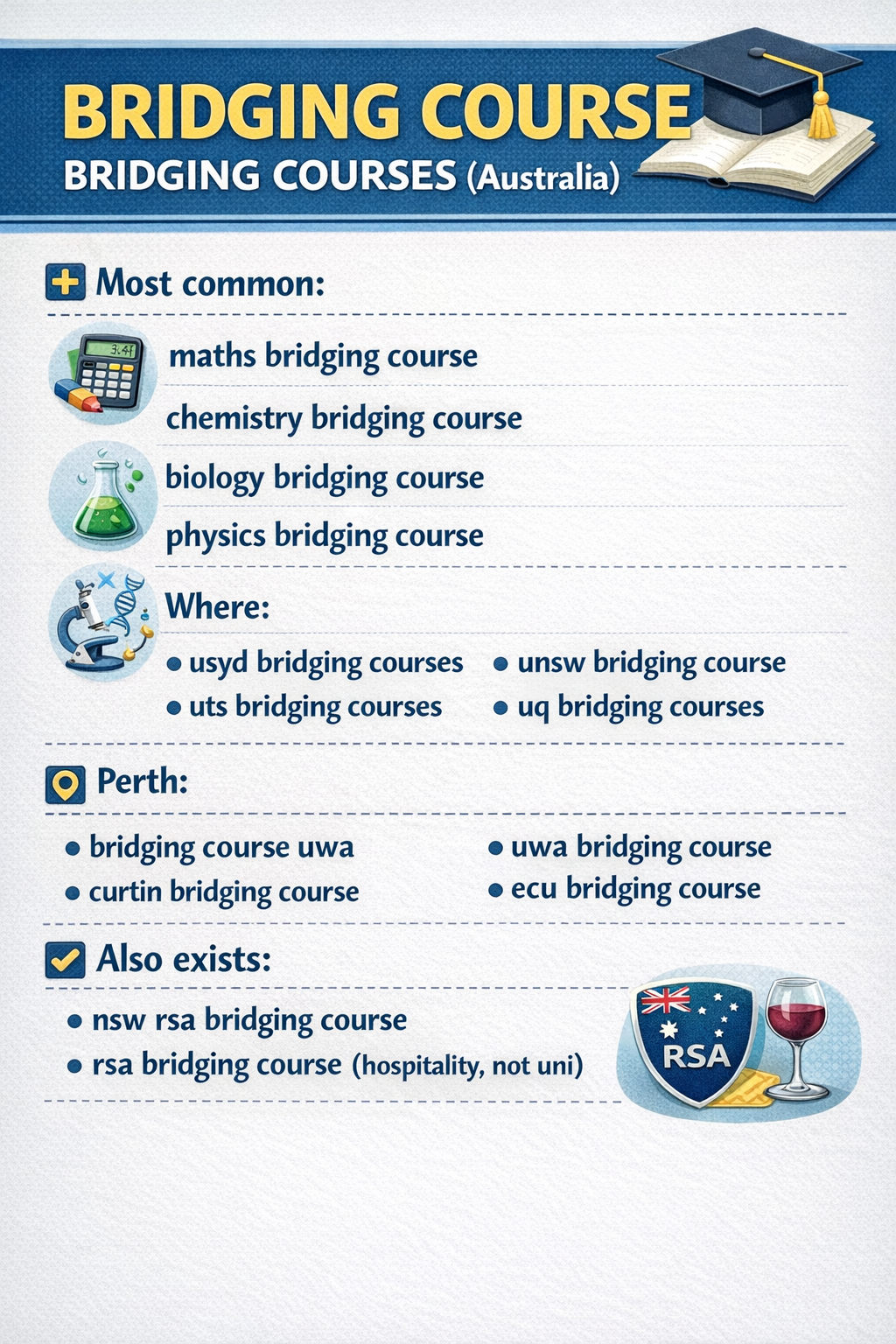
Next Steps
If you’re picking between a bridging course, an enabling program, or a TAFE pathway, tell PickMyUni:
your target degree
the subject you’re missing (maths/chem/physics/biology)
your intended start date
We’ll help you shortlist the options that match your timeline and budget — and if you’ve taken one before, leave a review on PickMyUni so other students can avoid the trial-and-error.